Get a BMC-84 Bond – ICC Broker Bond Instantly!

Your Freight Broker Bond,
Done Right
The BMC-84 surety bond is a federal requirement for every freight broker in the U.S. We simplify the process — competitive rates, fast approval, and full FMCSA filing handled for you.
Understanding the Basics
What is a Freight Broker Bond?
A BMC-84 surety bond is the financial guarantee the federal government requires before you can legally operate as a freight broker or forwarder in the United States.
A freight broker bond — officially the BMC-84 — is a three-party agreement mandated by Title 49, U.S.C. §13904. It guarantees that you, as a licensed freight broker, will pay motor carriers and shippers on time and operate within federal regulations. If you fail to meet those obligations, harmed parties can file a claim against your bond for compensation up to the full $75,000 amount.
The bond does not mean you hand over $75,000 upfront. Instead, you pay a small annual premium — a percentage of the total bond amount determined by a surety underwriter based on your creditworthiness, business history, and risk profile. Think of it as insurance that protects everyone in the supply chain.
Without this bond, the FMCSA will not grant you brokerage authority, and operating without one is a federal offense that can result in fines, lawsuits, and permanent revocation of your license.
✓ Protects Motor Carriers — Ensures carriers get paid after delivering freight on your behalf.
✓ Protects Shippers — Provides a financial backstop if a broker mishandles shipments or funds.
✓ Ensures Regulatory Compliance — Acts as proof that you meet FMCSA standards before brokerage authority is granted.
✓ Builds Industry Trust — Carriers and shippers prefer bonded brokers, opening doors to more contracts and partnerships.
✓ Required by Federal Law — No exceptions. Every freight broker and forwarder must obtain this bond or a trust fund alternative (BMC-85).
Legal & Regulatory Framework
Federal Laws & Regulations
The freight broker bond requirement is rooted in well-established federal statutes. Here are the key references.
49 U.S.C. § 13904
Registration of Brokers — Requires all freight brokers to register with the FMCSA and maintain proof of financial responsibility through either a surety bond or a trust fund agreement.
49 CFR § 387.307
Surety Bonds and Trust Fund Agreements — Specifies the $75,000 bond amount, acceptable forms of financial responsibility, and the procedures for filing bonds with the FMCSA.
49 U.S.C. § 13906
Financial Responsibility — Outlines the Secretary of Transportation’s authority to enforce financial responsibility requirements for brokers and the consequences of non-compliance.
Federal Motor Carrier Safety Administration (FMCSA) Regulations
The Federal Motor Carrier Safety Administration (FMCSA) plays a crucial role in regulating the freight brokerage industry. To ensure compliance with federal regulations, the FMCSA mandates that all freight brokers and freight forwarders obtain a surety bond, commonly known as a BMC-84 bond. This bond amount is set at $75,000 and serves as a financial guarantee to protect the interests of shippers and motor carriers.
Under FMCSA regulations, freight brokers are required to:
- Obtain a freight broker surety bond (BMC-84) or a trust fund agreement (BMC-85).
- Register with the FMCSA and obtain a motor carrier number (MC number).
- Maintain accurate records of their business operations.
- Comply with federal regulations regarding safety, insurance, and financial responsibility.
- Pay motor carriers in a timely manner.
Failure to adhere to these regulations can result in severe penalties, fines, and even the revocation of the freight broker’s license. By following FMCSA guidelines, freight brokers can ensure they operate legally and maintain a good standing in the industry.
State-Specific Requirements
The $75,000 BMC-84 bond is a nationwide federal requirement. However, certain states layer on additional obligations that you must also satisfy, such as a fuel tax bond (IFTA) for businesses that report and pay interstate motor fuel taxes.
| State | Federal Bond | Additional Requirements | Notes |
|---|---|---|---|
| California | $75,000 BMC-84 | Additional Filing | May require state-level registration with CALTRANS for certain operations. |
| Texas | $75,000 BMC-84 | State Registration | TxDOT registration is required for brokers headquartered in Texas. |
| Florida | $75,000 BMC-84 | Additional Filing | The Florida Department of Transportation may require supplemental documentation. |
| New York | $75,000 BMC-84 | State Registration | NY DOT has its own broker registration process that runs parallel to the federal one. |
| Illinois | $75,000 BMC-84 | — | Federal bond satisfies state requirements. No additional filing needed. |
| Georgia | $75,000 BMC-84 | — | Federal bond satisfies state requirements. |
| Pennsylvania | $75,000 BMC-84 | Additional Filing | PennDOT may require proof of bond alongside state business registration. |
| Ohio | $75,000 BMC-84 | — | Federal bond satisfies state requirements. |
How Freight Broker Bonds Work
How Freight Broker Surety Bonds Work (our really short Freight Brokers Bond Guide)
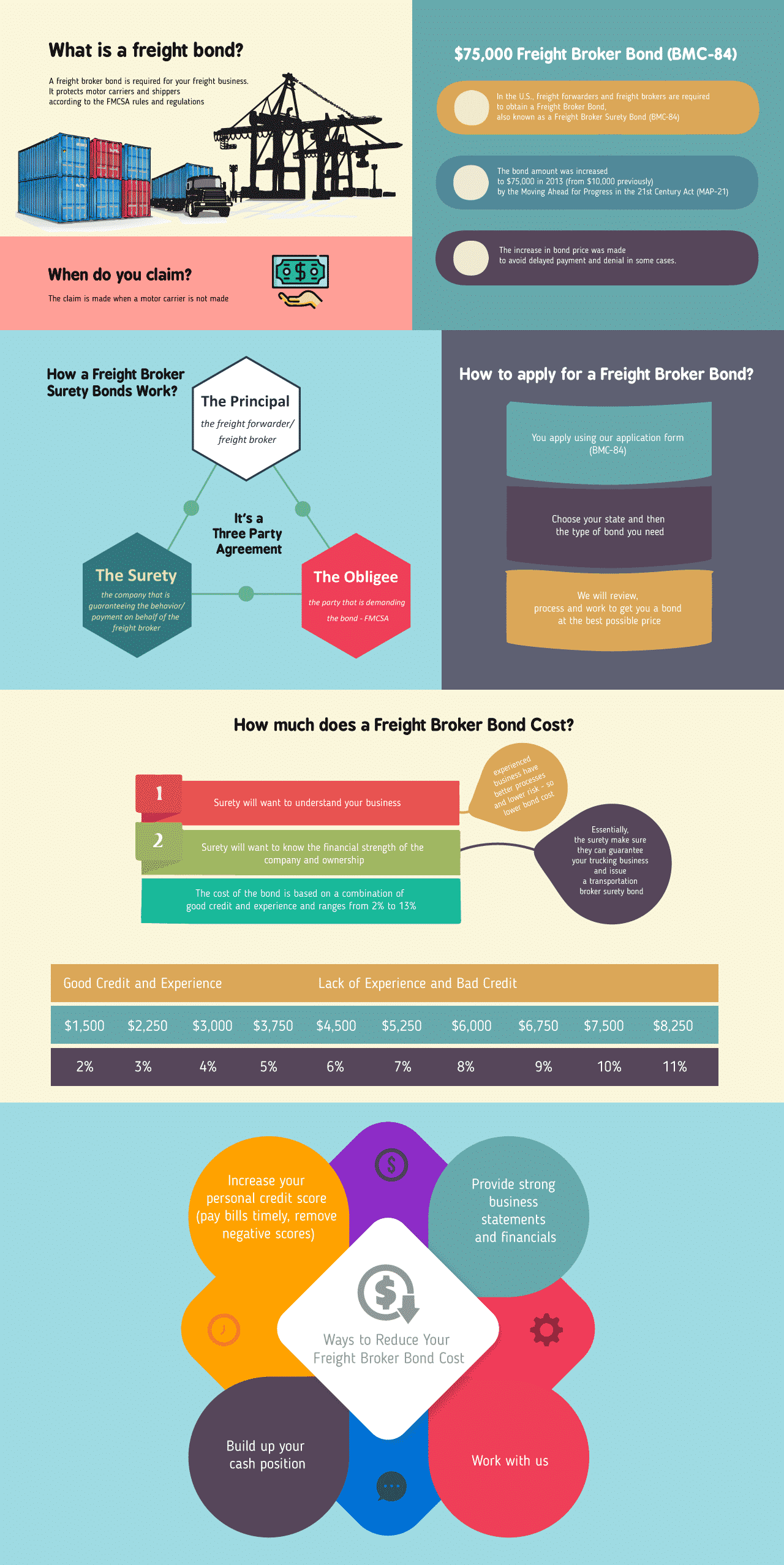
The cost of the bond depends on several factors. Choosing a reputable bond company is crucial because they handle claims and ensures that the interests of all parties are protected. First, the surety will want to understand your business, as more experienced businesses typically have better processes in place to reduce risk, which lowers the bond cost. Lower-risk companies often secure better rates on their insurance premiums. Second, the surety will seek approval regarding the financial health of your business from an authority figure, perhaps an overseer or a financial analyst. They will also be interested in the owner’s personal credit history and financial strength. Given that the standard BMC-84 (Freight Broker Surety Bond) is offered without collateral, the surety is probing the company’s and ownership’s financial stability and experience. This is to ensure protection and coverage against potential liability. Security is paramount to the surety, as it wants to be certain that it can appropriately guarantee your trucking business by issuing a trucking surety bond (or transportation broker surety bond).
The Three Parties Involved
Every surety bond is a legally binding agreement between three distinct parties, each with defined roles and responsibilities.

Benefits & Purpose
Benefits of a Freight Broker Bond
A freight broker bond offers numerous benefits to freight brokers, shippers, and motor carriers. Here are some of the key advantages:
- Ensures Compliance with FMCSA Regulations: A freight broker bond helps brokers meet all federal requirements, helping them avoid legal issues.
- Protects Shippers and Motor Carriers: The bond provides a financial safety net, protecting shippers and motor carriers from potential losses due to non-payment or other issues.
- Promotes Credibility and Trust: A bonded freight broker is seen as more reliable and trustworthy, which can attract more business.
- Provides a Financial Guarantee: The bond guarantees that freight brokers will pay motor carriers, fostering a more secure business environment.
- Prevents Fraud and Unethical Practices: By requiring a bond, the industry reduces the risk of fraud and unethical practices and promotes ethical behavior.
- Cost-Effective Alternative to a Trust Fund Agreement: Compared with establishing a trust fund agreement, obtaining a bond is often more affordable and less cumbersome.
- Focus on Business Operations: With the financial risks mitigated, freight brokers can concentrate on growing their business without worrying about potential liabilities.
Overall, a freight broker bond is an essential requirement for freight brokers to operate legally and maintain a good reputation in the industry. It not only ensures compliance but also builds trust and credibility, making it a valuable asset for any freight brokerage.
Risks of Operating Without a Bond
🚫 License Revocation
The FMCSA can immediately suspend or permanently revoke your brokerage authority if you operate without a valid bond.
💸 Heavy Fines
Federal penalties for non-compliance can reach thousands of dollars per violation, compounding with each day you operate illegally.
⚖️ Civil Lawsuits
Carriers and shippers can sue you directly for unpaid amounts or damages, with no bond to absorb the financial blow.
📉 Reputation Damage
An unbonded broker loses credibility instantly. Carriers and shippers actively avoid working with unverified brokers.
🚪 Reapplication Bar
After revocation, the FMCSA may impose a waiting period before you can reapply for brokerage authority.
📰 Public Record
FMCSA enforcement actions are public. Violations become part of your permanent record, visible to anyone in the industry.
Cost & Pricing
How much does a Freight Broker Bond Cost?
How Much Will a $75K Bond Cost Me?
The cost of the bond is determined by the conjunction of good credit and experience, generally ranging from < 2% to 13%. The cost can vary depending on the surety company you choose, as different companies offer varying rates and terms. This rate, though, can fluctuate depending on several factors including the degree of liability coverage and protection measures in place. Seeking contract approval from authorities could also play a role.
Take the next step and apply for a Federal Motor Carrier Safety Bond (BMC-84) using our form, above. Not only will we assess your application for accuracy, but we’ll also expedite the approval process ensuring timely shipping of your bond. We will review and process your freight broker bonds application, providing compensation for our drivers’ efforts promptly.
The cost of the bond is based on a combination of good credit and experience and ranges from < 2% to 13%.
Application & Documentation
How to Get Your Freight Broker Bond
SwiftBonds walks you through every step — from application to FMCSA filing — so you can focus on building yo brokerage.
1. Set Up Your Business Entity
Register your company with your state and obtain an Employer Identification Number (EIN) from the IRS. This is the legal foundation everything else is built on.
2. Apply for FMCSA Authority
Submit Form OP-1 (Application for Motor Property Carrier and Broker Authority) to the FMCSA. Expect 4–6 weeks for processing. Pay the $300 non-refundable application fee.
3. Designate a BOC-3 Agent
Appoint a process agent who can accept official documents on your behalf. Some brokers in their home state may designate themselves.
4. Get Your Freight Broker Bond
Submit your application through SwiftBonds. Our team reviews your profile, matches you with the best surety carrier, and guides you through underwriting. Most bonds are approved in 24–48 hours.
5. File Your Bond with the FMCSA
SwiftBonds handles electronic filing directly with the FMCSA on your behalf — no paperwork hassle on your end. The FMCSA now requires all bond submissions electronically.
6. Activate Your Brokerage Authority
Once your bond and insurance filings are complete and accepted, the FMCSA issues your operating authority. You are now legally cleared to operate as a freight broker.
What Documents Do You Need?
Have these ready before you apply to avoid delays and ensure the fastest possible approval.
Fill out SwiftBonds’ online application with your personal and business information. Takes under 10 minutes.
Your company name, structure (LLC, Corp, etc.), registered address, and EIN from the IRS.
Government-issued ID for all business owners. The surety uses this to verify your identity and pull your credit.
The surety will run a personal credit check on all business owners. A higher score means a lower premium.
If you already have a Motor Carrier number from a previous OP-1 filing, include it. Otherwise, you can apply with personal info only.
Some sureties may request business financial statements or tax returns during underwriting, especially for higher-risk applications.
Bond Types & Comparisons
BMC-84 Surety Bond vs. BMC-85 Trust Fund
The FMCSA gives you two paths to meet the financial responsibility requirement. Here’s how they stack up.
BMC-84 Surety Bond ✓ Recommended
Pay only a small annual premium
- Pay 1.25%–10% of $75,000 annually ($938–$7,500)
- No large upfront capital required
- Surety company backs the bond — covers claims on your behalf first
- Best for new brokers, small operations, and startups
- Premium may decrease over time as your business matures
- SwiftBonds handles filing, renewals, and claims support
BMC-85 Trust Fund
Deposit the full $75,000 upfront
- Requires depositing the entire $75,000 into a trust account
- Funds are locked — cannot be used for business operations
- No ongoing premium payments after initial deposit
- Only practical for large, financially established brokerages
- Full control — no surety company involved
- FMCSA tightening rules: trust funds must now use liquid assets only (Jan 2026)
Claims & Protection
What Happens When a Claim Is Filed?
Understanding the claims process is critical for every freight broker. Here’s exactly how it works — and how to protect your business.
⚠️Common Reasons for Claims
Most claims stem from payment disputes between brokers and carriers.
-
- Broker fails to pay a motor carrier after freight is delivered
- Broker mishandles or loses shipper funds
- Broker violates FMCSA regulations or license conditions
- Broker provides fraudulent documentation to carriers or shippers
- Broker operates outside the scope of their brokerage authority
📋The Claims Process
Here’s what happens step by step when a claim is made against your bond.
- Step 1: The harmed party (carrier or shipper) files a claim with the surety company
- Step 2: The surety investigates the claim and determines if it is valid under bond terms
- Step 3: If valid, the surety pays the claim up to the $75,000 bond amount
- Step 4: You, as the principal, are legally required to reimburse the surety for the full amount paid
- Step 5: Repeated or unresolved claims may result in FMCSA suspending your authority
Ongoing Compliance
Renewal & Bond Maintenance
Your bond is valid for one year. Here’s everything you need to know about keeping it active and improving your rate over time.
🔄 Annual Renewal
Your bond must be renewed every year before the expiration date. SwiftBonds sends you a renewal reminder well in advance. Simply pay your new premium and we handle the re-filing with the FMCSA.
📈 Lower Rates Over Time
As your business matures and your credit improves, you become a lower-risk applicant. Brokers with 3+ years of clean operations and strong credit often see their premiums drop significantly at renewal.
🔒 Cancellation Rules
If either you or the surety company wish to cancel the bond, a 30-day written notice must be provided to the FMCSA. Cancellation without a replacement bond will result in immediate suspension of your authority.
Insights & Educational Content
Freight broker bonds (BMC-84) require $75,000 minimum to protect carriers/shippers from non-payment or fraud by brokers arranging interstate transport. Amid a freight recession, claims surges and regulatory shifts are hardening the market.
Market Hardening
Two top surety carriers exited in 2023 due to rising claims; premiums now 1.25-15% ($938-$11,250/year) based on credit, up from softer pandemic rates.
Freight Volume Surge
Parcel volumes exceeded forecasts: 2020 actual 19.5B vs 17.3B expected; 2021 21.7B vs 18.7B, fueling broker influx (17,500 new licenses 2021, +60% YoY).
Brokerage Growth
U.S. freight brokerage hit $12.67B in 2024, projected $23.32B by 2034 (6.29% CAGR); global $58.19B in 2025 to $98.73B (6.05% CAGR).
Claims Outcomes
Payouts full if under $75k, pro-rata if exceeded; invalid if outside bond term or no liability proof; new 2026 FMCSA rules enforce stricter $75k cash equivalents.
Fraud Impact
Freight fraud losses topped $455M in 2024; double brokering and identity theft drive claims, with 88,000 trucking firms closing 2023.
| Metric | Value | Note /[page:id] |
|---|---|---|
| Premium Range | $938-$11,250/yr | Good/poor credit |
| New Licenses 2021 | +60% (17,500) | Pandemic peak |
| U.S. Market 2034 | $23.32B | 6.29% CAGR |
| Fraud Losses 2024 | $455M | Double brokering etc. |
| Parcel 2021 | 21.7B (vs 18.7B exp) | COVID surge |
Frequently Asked Questions
What is a freight broker bond and why do I need one?
How much will I actually pay for the bond?
Can I get a bond if I have bad credit?
How long does it take to get approved?
What is the difference between a BMC-84 and a BMC-85?
A BMC-84 is a surety bond where you pay only a small annual premium — the surety company backs the bond. A BMC-85 is a trust fund agreement where you must deposit the full $75,000 into a trust account. The BMC-84 is the preferred and most common option, especially for newer brokers, because it requires far less upfront capital. Starting January 2026, the FMCSA is also tightening rules on trust funds, requiring liquid assets only.
Do I need to renew my bond every year?
What happens if someone files a claim against my bond?
Are there extra requirements in certain states?
What documents do I need to apply?
You will typically need: a completed bond application, your business entity information (name, structure, EIN, address), personal identification for all owners, and your FMCSA MC number if you already have one. Some applicants may also be asked for business financial statements or tax returns, depending on the surety’s underwriting requirements.
Can I cancel my bond if I no longer need it?
Yes, but a 30-day written notice must be provided to the FMCSA before cancellation takes effect. If you cancel without having a replacement bond in place, your brokerage authority will be immediately suspended. Always ensure you have continuous bond coverage if you intend to keep operating.
Ready to Get Bonded?
Join thousands of freight brokers who trust SwiftBonds to handle their BMC-84 bond — from application to FMCSA filing and beyond.
See our License and Permit Bond page for more. Click here for more on bonds.